

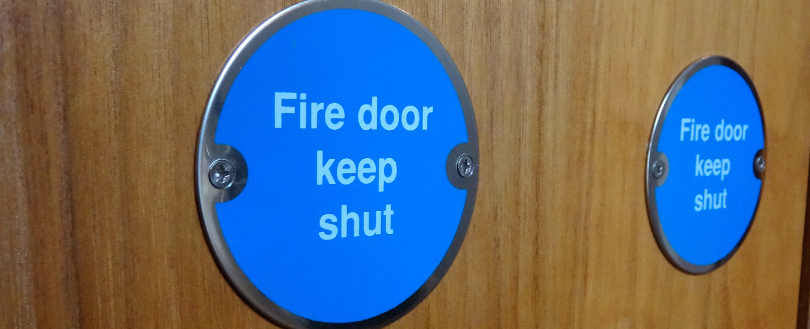
Fire Door Safety Week: What makes a fire door work?
Like it? Share it!
21 September 2026
This week marks Fire Door Safety Week, which aims to raise awareness of the importance of fire doors and the role they play in protecting people and property.
When most people think of a fire door, they probably think about the door itself. But there is much more to it than meets the eye. A fire door relies on a number of different components working together, and something seemingly quite small can affect how the complete door performs.
So, what actually makes a fire door work?
More than just the door
Fire doors form part of a building’s passive fire protection. Their purpose is to resist the spread of fire and, where required, smoke between different areas of a building for a specified period of time.
That can help protect escape routes, support the building’s compartmentation and give occupants time to escape.
But it isn't just the door leaf doing all of that work. The frame, seals, glazing, hinges, closer and other ironmongery can all contribute to the performance of the complete fire door assembly.
This is why the different components can't really be looked at in isolation. They need to be suitable for the particular door and compatible with the evidence supporting its fire performance.
Door leaf and frame
The door leaf is the part we tend to think of as the fire door itself, but it has been designed and tested to work as part of an assembly.
The frame is just as important. The leaf needs to sit correctly within it, with appropriate gaps around the door, and the frame itself needs to be suitable for the particular fire door assembly.
Changing the leaf or frame without considering the rest of the assembly could affect the fire performance, even if the replacement looks very similar to what was there before.
Intumescent and smoke seals
You'll often see seals fitted into the edge of a fire door or its frame, but not all seals do the same job.
Intumescent seals react when exposed to heat and expand to help seal the gaps between the door leaf and frame during a fire.
Smoke seals have a different job. Where smoke control is required, they help restrict the passage of smoke through the gaps around the door before temperatures become high enough to activate an intumescent seal.
The two functions are often combined into one product, which is why the distinction isn't always obvious just by looking at the door.
Not every fire door will necessarily have the same arrangement, particularly older doors, so the absence of a particular type of seal shouldn't automatically be taken to mean that the door is unsuitable.
Door closers
Where a fire door is required to be self-closing, the closer has a really important job: making sure the door reliably returns to its closed position.
A fire door that is left partly open can't provide the protection it was intended to provide, so it needs to be suitable for the door and capable of closing it fully into the frame. If it has been incorrectly adjusted, damaged or replaced with something unsuitable, the door may no longer close properly.
There are also situations where fire doors can legitimately be held open using suitable automatic release devices. The important thing is that the arrangement is appropriate and allows the door to close when required.
Hinges and other ironmongery
Hinges, locks, latches, handles and other hardware might seem like fairly ordinary parts of a door, but on a fire door they matter.
The components need to be suitable for use with that particular door and fitted correctly. Alterations such as changing hinges, fitting additional locks or drilling into the door for new hardware shouldn't be made without considering whether they could affect its fire performance.
This is particularly important when doors are repaired or upgraded over their lifetime. Something being a good-quality door component doesn't necessarily mean it is suitable for every fire door.
Glazing
Fire doors can include glazed panels, but the glass and the way it is fitted form part of the fire-resisting construction.
Fire-resisting glazing isn't simply a case of putting fire-rated glass into an opening. The glass, glazing system, beads, fixings and permitted dimensions all need to be appropriate for the door.
Older doors can sometimes contain wired fire-resisting glass without the markings we might expect to see on newer products. The absence of a visible marking alone doesn't necessarily mean that an existing door is unsuitable, although damaged or questionable glazing should be investigated.
Other components
Depending on its design and use, a fire door might also contain components such as letterplates, air transfer grilles, vision panels or other specialist hardware.
Again, the important point is compatibility. Cutting a new opening or adding something to an existing fire door can potentially affect its performance, so alterations need to be properly considered rather than treated in the same way as alterations to an ordinary door.
It all has to work together
Perhaps the most important message during Fire Door Safety Week is that a fire door isn't just a door leaf with a label on it.
Its performance depends on the complete assembly and how its different components work together. Specification and installation matter, but so do the changes, repairs and maintenance carried out throughout the life of the door.
In our next article, we'll look at the practical side: what to look out for when checking fire doors, common problems, maintenance and when a door might need repair, further assessment or replacement.
Author: Emma Francioli, Technical Officer, Fire Industry Association