

Wildfire Risk Intensifies Across the UK
Like it? Share it!
17 August 2026
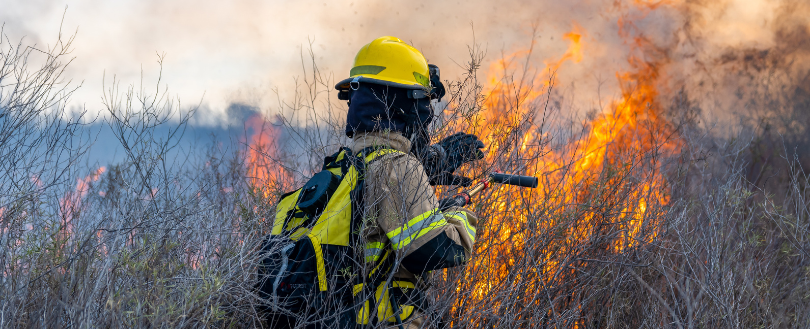
Fire and Rescue Services across the UK are responding to a sustained period of heightened wildfire risk, as prolonged dry conditions and extreme temperatures continue to create challenging conditions for firefighters.
The latest incidents come during the fifth heatwave of the summer, with drought and exceptionally dry ground allowing fires to ignite and spread rapidly. While wildfires present an immediate threat to the natural environment, the consequences can become significantly more serious when fires reach the urban fringe and begin to threaten homes and communities.
Recent incidents have demonstrated the potential impact. A significant number of properties in Stourbridge, West Midlands, have reportedly been destroyed or severely damaged, with further properties affected in Sandwell, Stoke-on-Trent and Pershore.
The National Fire Chiefs Council (NFCC) has warned that wildfire risk is developing faster than the collective capacity to respond. Climate change, prolonged periods of extreme heat and changes in land use are contributing to wildfires that are more frequent, larger and increasingly complex.
Highlighting the need to strengthen resilience, the NFCC said: “We must ensure that investment is not only sustained, but also enhanced if we’re to keep pace with the risks now facing our communities.”
Traumatic experience
Phil Garrigan, chair of the NFCC, stated: “Our thoughts are with those families and communities who’ve been affected by these devastating fires. Losing a home and/or treasured possessions or being forced to leave your community is a traumatic experience that can have a lasting impact.”
Garrigan continued: “We also recognise the extraordinary efforts of firefighters, Control Room teams and support staff who continue to work around the clock in extremely challenging conditions to protect life, property and the environment.”
Further, Garrigan explained: “Recent incidents have demonstrated how rapidly fires can spread and how the threat is evolving. Wildfires are no longer confined to remote rural areas. Increasingly, they’re threatening homes, businesses and critical infrastructure as they move from open land into urban and suburban communities.”
The NFCC welcomes the Government’s recognition of the escalating threat through recent investment in specialist wildfire capabilities and the Prime Minister’s decision to convene COBR in response to the current conditions. “The support and recognition of these risks is welcome and reflects the seriousness of the situation we are facing,” affirmed Garrigan.
New reality
Garrigan went on to comment: “Our new reality is that risk is growing faster than our collective capacity to respond. Climate change, prolonged periods of extreme heat and changing land use are creating more frequent, larger and more complex wildfires. We must ensure that investment is not only sustained, but enhanced if we are to keep pace with the risks facing our communities.”
While Garrigan agrees that it’s right to focus on the ‘here and now’, the NFCC is calling for a long-term wildfire strategy that reflects the changing nature of emergencies facing the UK. This would include continued investment in firefighters, specialist wildfire teams, training, equipment and national capabilities, including a dedicated aerial firefighting capability.
“The cost of preparedness will always be less than the cost of recovery,” said Garrigan. “We must act now to ensure Fire and Rescue Services have the resources required to protect communities from increasingly severe and complex wildfire events.”
The public also has a vital role to play. “Many wildfires are preventable,” outlined Garrigan. “At a time when firefighters are responding to multiple major incidents across the country, the most effective action anyone can take is to avoid activities that could ignite a fire.”
Shared responsibility
Garrigan observed: “We all have a shared responsibility to protect our communities. By making sensible choices and following local guidance, people can help to prevent further devastation, reduce pressure on the Emergency Services and keep firefighters available for those who need them most.”
In conclusion, Garrigan stated: “Every wildfire prevented is a home protected, a family spared the heartbreak of losing treasured possessions and firefighters freed to respond to other emergencies. Public vigilance and responsible behaviour are every bit as important as any piece of equipment in helping us to tackle this growing threat.”
The West Midlands Fire Service was alerted to a significant grass fire at Stourbridge Golf Course at around 1.30 pm on 13 August. At the height of the multi-agency response, which is continuing, upwards of 100 firefighters, 30 fire engines and no fewer than 11 specialist teams were at the scene.
Having spread rapidly, the devastating fire impacted 37 properties, 19 of which have been destroyed, while a further 18 have sustained substantial damage. The incident has covered an area of approximately 500 acres.
At this point in time, the cause of the fire isn’t known. Specialist fire investigators are working to establish the circumstances.
Macclesfield Forest wildfire
The scale and complexity of the challenge was illustrated by the recent wildfire at Macclesfield Forest, where a six-day firefighting operation involving Cheshire Fire and Rescue Service and partner agencies concluded shortly after 4.15 pm on 27 July.
The incident began on 21 July, with firefighters tackling a large woodland and grass fire across difficult terrain and in challenging conditions. At its peak, crews worked alongside Cheshire Police, United Utilities and forest volunteers to prevent the fire from spreading further.
Specialist wildfire firefighters deployed a range of equipment and tactics, including beaters, water backpacks, hose reel jets, thermal imaging cameras, drones and an all-terrain vehicle. A United Utilities helicopter also supported operations by carrying out repeated water drops over affected areas.
Firefighters remained at the scene around the clock throughout the incident, monitoring conditions, identifying hotspots and working to prevent further flare-ups. The remote location and difficult terrain required a carefully co-ordinated and sustained multi-agency response.
An investigation during the incident identified a discarded disposable barbecue as the most probable cause of the fire.
The recent incidents underline the changing nature of wildfire risk in the UK. As periods of extreme heat and prolonged dry weather become increasingly significant considerations for fire and rescue services, prevention, preparedness and appropriate investment will be essential to protecting people, property and the wider environment.
View the source.
Our eNews provides regular insight into industry trends, news headlines, and product and service information. For more articles like this Subscribe to our enews.